



What Is the Best Wedding Band Width for Petite Fingers?

Last Updated: November 26, 2026
Quick Summary
A slim band is generally the best choice for petite fingers, because it keeps the hand looking balanced rather than overwhelmed. For most petite fingers, a wedding band width of 2mm to 2.5mm works well, while 3mm suits longer fingers and 4mm or more is best avoided on small hands.
- Most petite fingers show between 30mm and 45mm of visible length from base to knuckle.
- A band covering more than roughly one third of the finger's width will look heavy on a petite hand.
- A 2mm band shows wear sooner and offers less metal for resizing than a heavier band.
- On a petite finger, a combined engagement and wedding band width above roughly 5mm to 6mm starts to cover most of the visible finger.
- Three 1.5mm stacked bands add up to 4.5mm of combined width, already close to the limit for a short finger.
Table of Contents
- What is the best wedding band width for petite fingers?
- Wedding ring width for small hands: a practical selection method
- Is a 2mm wedding band too thin?
- Wedding band width and thickness: why both measurements matter
- Choosing a wedding band to match your engagement ring
- Trying band widths in person at our Birmingham workshop
- Frequently Asked Questions
What is the best wedding band width for petite fingers?
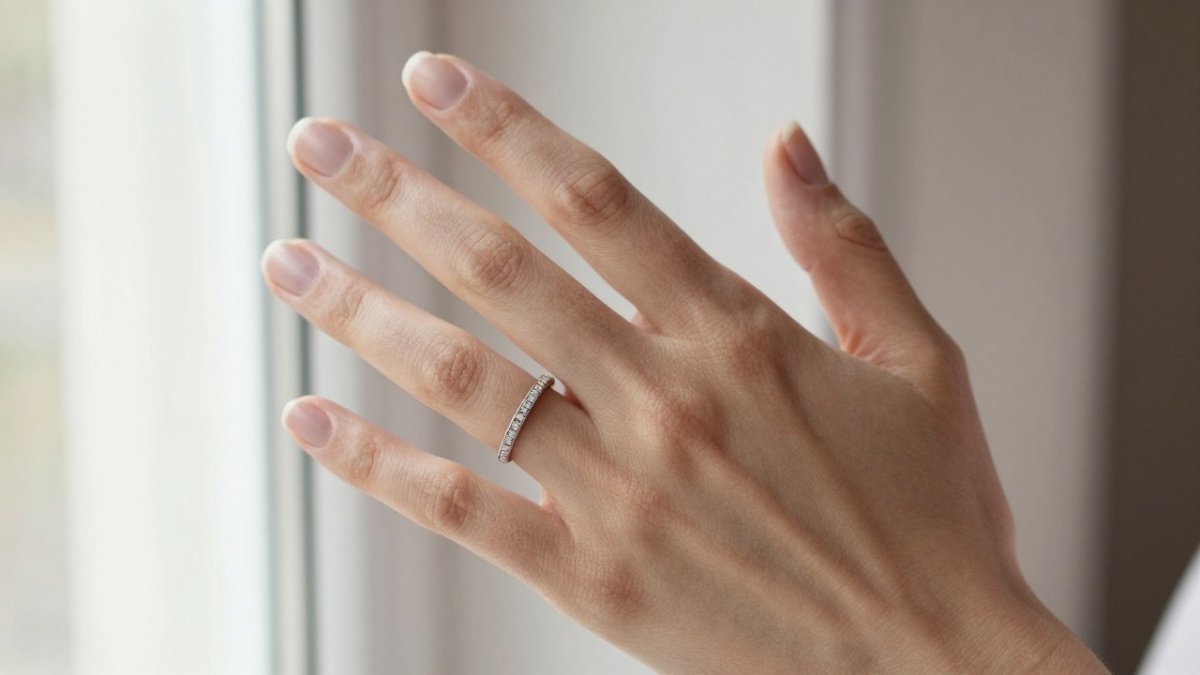
A slim band is generally the best choice for petite fingers, because it keeps the hand looking balanced rather than overwhelmed. Choosing a wedding band width is a question of proportion, not fashion. A narrow band generally flatters a small hand, while a wide one can make short fingers look shorter.
Below, we explain how to judge the right width for your own hand, along with the fit, comfort and pairing questions to consider.
Wedding ring width for small hands: a practical selection method
Wedding ring width for small hands comes down to matching the band to the visible length of your finger and the proportions of your hand, not to your ring size alone. Use this repeatable method before you commit to a measurement.
Step 1: Measure the visible finger length. Look at your ring finger from the base to the knuckle. Most petite fingers show between 30mm and 45mm of visible length.
Step 2: Compare band width to finger width. Hold a ruler across the finger at the widest point, usually just below the knuckle.
Step 3: Factor in ring size and knuckle shape. Ring size and finger length do not always move together.
Step 4: Try widths side by side under real light. Place 2mm, 2.5mm and 3mm bands on the same finger in one sitting.
Step 5: Check the pairing before you decide. Stack your proposed band next to your engagement ring. If the two together cover most of the visible finger, drop down a width.
The woman is British.
Watch out: Measuring only your ring size and choosing a width from a chart can lead you to a band that fits the finger circumference but looks out of proportion on a short finger.
How finger size and shape affect band proportions
Finger size and shape change how any given width reads on the hand. A ring size that sits at the smaller end of the scale usually pairs best with a slim band, because there is less surface area to fill. Short fingers benefit from a narrow profile that leaves length visible. Longer fingers can carry a medium or wider band without it looking out of place. Knuckle size matters too: a prominent knuckle makes a wide band harder to slide on and off, and it can make a 3mm band feel tighter than its measurement suggests. Two people with the same ring size can carry different widths comfortably if their visible finger lengths differ by even 5mm.
Comfort, fit, and resizing trade-offs
Comfort and future resizing are where width decisions get real. A wider band has more metal in contact with the skin, so it feels heavier and traps more moisture in warm weather. Slim bands feel lighter but can spin on the finger if the fit is loose. On resizing, a plain band is straightforward to adjust, while a band set with stones along the full circumference limits how much it can be altered. If you expect your finger size to change, keep the profile simple. Interior profile matters as well: a comfort-fit band, curved on the inside, slides on more easily than a flat interior, which is worth considering if you choose a wider band for a petite finger.
Is a 2mm wedding band too thin?
A 2mm wedding band is generally considered a delicate choice that can suit petite fingers, as it adds sparkle without bulk. The trade-offs are real, though. A 2mm band shows wear sooner than a heavier one, and it offers less metal if you ever need resizing. For everyday wear, many people find 2mm comfortable and barely noticeable, which is exactly the point. If you want a little more substance without going wide, 2.5mm is a common middle ground.
Wedding band width and thickness: why both measurements matter
Wedding band width and thickness are two different measurements, and confusing them is a common mistake. Width is the visible band across the finger, measured in millimetres. Thickness, sometimes called depth, is how far the band stands proud of the finger. A band can be narrow and thick, or wide and thin, and each combination feels different.
| Width | Look on a petite hand | Comfort | Best for |
|---|---|---|---|
| 2mm | Delicate, subtle | Light, barely felt | Small hands, stacking |
| 2.5mm | Balanced, noticeable | Comfortable everyday | Most petite fingers |
| 3mm | More presence | Slightly heavier | Longer fingers, solo wear |
| 4mm+ | Bold, bulky on small hands | Noticeable weight | Larger hands only |
A thick narrow band feels sturdy but can dig in at the sides. A thin wide band looks flat and can dent more easily. For petite fingers, a moderate thickness with a slim width can feel solid without looking heavy. You can browse women's plain diamond wedding rings to see how different widths sit in real designs.
Choosing a wedding band to match your engagement ring
Choosing a wedding band to match your engagement ring is about visual balance between the two pieces, and on a petite finger the combined width matters as much as each band on its own. A delicate engagement ring with a fine shank pairs naturally with a 2mm band. A heavier solitaire can take a 2.5mm or 3mm band without the pair looking mismatched, but on a short finger the two together should still leave visible skin on either side.
Combined visual width. Add the width of your engagement ring shank to the width of the wedding band. On a petite finger, a combined width above roughly 5mm to 6mm starts to cover most of the visible finger and can make the hand look shorter.
Gaps and contouring. Curved or shaped bands sit flush against a shaped engagement ring, while straight bands leave a small gap that some people love and others dislike. If your engagement ring has a low-set stone or a cluster, a contoured band follows the outline and avoids rubbing.
Stacking. If you plan to stack, keep each band slim so the stack stays comfortable and does not overwhelm a petite finger. Three 1.5mm bands can add up to 4.5mm of combined width, which is already close to the limit for a short finger.
Stone settings. A band set with stones along the full circumference has less metal available for resizing and can feel tighter than a plain band of the same width. On a petite finger, a half-eternity or channel-set band often gives sparkle without the bulk of a full eternity setting.
Explore women's diamond wedding rings and bands and diamond eternity rings to compare how slim bands pair with different settings, and try your engagement ring alongside each option in person so you can judge the combined width on your own hand.
Trying band widths in person at our Birmingham workshop
Trying band widths in person at our Birmingham workshop is the fastest way to settle the question. Photographs help, but a band on your own hand under real light tells you what no image can. Trying a range of widths side by side, comparing profiles, and feeling the difference in weight is the best way to judge fit. You can see a classic court shaped plain wedding band as a starting point for comfort and fit.
If you are looking for a bespoke wedding band, you can discuss a custom width with our team. We offer a lifetime guarantee including cleaning, polishing, and resizing. For a deeper look at choosing width for small hands, read our guide on how to choose a wedding band width for small hands.
Finding the right width for a petite hand is easier when you can try bands on your own finger and compare them side by side. Marlows Diamonds brings over 70 years of family expertise, GIA-certified diamonds and an in-house workshop for bespoke pieces, backed by lifetime aftercare and a 30-day return policy. Get started with Marlows Diamonds and find a band that sits in perfect proportion on your hand.

FAQ's
Some of the most common Q&A's