



Hallmarks to Check When Buying Fine Jewellery
Last Updated: November 15, 2026
Quick Summary
The hallmarks to check on fine jewellery are the purity mark, the assay office symbol, the date letter and the sponsor's mark. Together they confirm the metal type, fineness and that an independent office tested the piece. For example, 750 means 18ct gold, which is 75 per cent pure gold.
- Look for the fineness mark, such as 375, 585, 750 or 916 for gold.
- 925 indicates sterling silver and 950 indicates platinum.
- A complete UK hallmark includes the fineness, assay office, date letter and sponsor's mark.
- Use a 10x loupe or phone macro mode to read small marks clearly.
- Ask for a written invoice stating metal and fineness when no hallmark is present.
Table of Contents
- Why Hallmarks Matter When You Buy Fine Jewellery
- Gold Hallmark Symbols and Meanings
- How to Check a Jewellery Hallmark in Person
- UK Hallmarking Exemptions and What They Mean for Buyers
- Diamond Engagement Ring Buying Checklist
- Booking Your Bespoke Consultation at Marlows Diamonds in Birmingham
- Frequently Asked Questions
Why Hallmarks Matter When You Buy Fine Jewellery
A hallmark is the official mark showing a piece's precious metal content. In the UK, it is your first and most reliable check on what you are paying for.
Hallmarking is a legal requirement for precious metal items sold in the UK above a certain weight (Hallmarking: practical guidance - summary). Independent Assay Offices test the metal and apply the marks, giving you protection a seller's own claim cannot provide (Hallmarking).
Hallmarks help you in three main ways:
- They confirm the metal type and fineness of the piece
- They show which Assay Office tested it
- They identify the maker or sponsor who submitted it
Many buyers assume a piece is solid gold because it looks heavy or bright. A hallmark replaces that guesswork with a verifiable record.
Gold Hallmark Symbols and Meanings
Gold is hallmarked by its fineness, which is the parts of pure gold per thousand. The mark you see tells you how much pure gold the alloy contains.
Common gold purity marks: 375, 585, 750 and 916
The four most common gold marks you will see are:
- 375 - 9ct gold, which is 37.5 per cent pure gold
- 585 - 14ct gold, which is 58.5 per cent pure gold
- 750 - 18ct gold, which is 75 per cent pure gold
Higher numbers mean more gold in the alloy. A 750 piece is richer in gold than a 375 piece. Choose the purity that fits your budget and how you plan to wear the piece.
Silver and platinum marks you will see
Silver and platinum carry their own marks. Look for:
- 925 - sterling silver, which contains 92.5 per cent pure silver
- 950 - platinum, a very pure metal used in many fine engagement rings
A piece marked 925 indicates sterling silver. Platinum is marked 950.
The table below summarises the main gold, silver and platinum purity marks covered in this section.
| Mark | Metal | Purity |
|---|---|---|
| 375 | 9ct gold | 37.5 per cent pure gold |
| 585 | 14ct gold | 58.5 per cent pure gold |
| 750 | 18ct gold | 75 per cent pure gold |
| 916 | 22ct gold | 91.6 per cent pure gold |
| 925 | Sterling silver | 92.5 per cent pure silver |
| 950 | Platinum | Very pure platinum |
How to Check a Jewellery Hallmark in Person
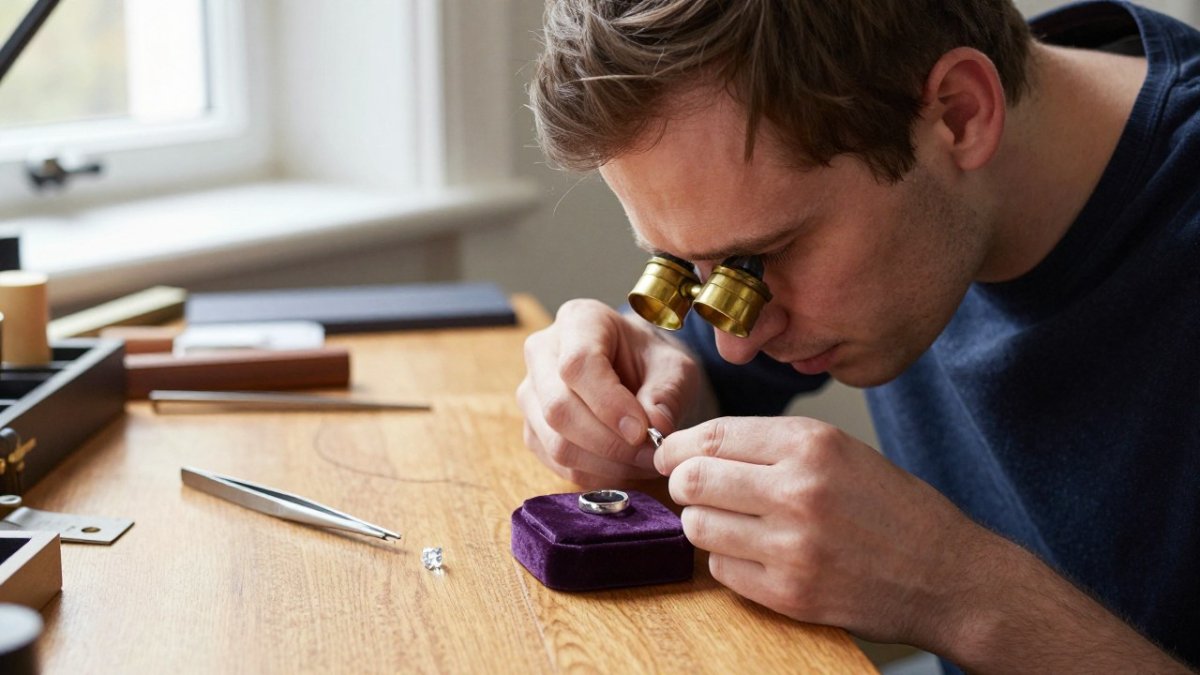
Checking a hallmark takes only a few minutes, but you need good light, a magnifier and a consistent method for the hallmarks to check. Ask the jeweller to show you the mark and take your time. A 10x jeweller's loupe is ideal, though a phone camera in macro mode can capture a clear image to compare later.

Reading the components: assay office, date letter and sponsor's mark
A complete UK hallmark usually includes four parts:
- The fineness mark - the purity number, such as 750
- The assay office mark - the symbol of the office that tested the metal
- The date letter - a letter that shows the year of hallmarking
Birmingham is one of the UK's four Assay Offices, and its mark is an anchor. Knowing these marks helps you confirm the piece went through a recognised testing process. Always check the other components too, a mark can be copied, and the combination of fineness, assay office, date letter and sponsor is harder to fake convincingly.
A practical inspection checklist for buying in person:
- Locate the mark - check the inside of the band, the clasp, the bail, or the back of the piece. On rings, it is usually on the inner shank; on chains, on the tag or clasp.
- Use a loupe or phone macro - steady your hand and take a photo if the mark is small. Compare it with a published hallmark reference chart (the Assay Office websites publish free guides).
- Check each component - confirm the fineness number matches the metal claimed, the assay office symbol is correct, the date letter is plausible for the piece's style, and the sponsor's mark is present.
- Check every component of the item - on a ring with a setting, the band and setting may carry separate marks; on a necklace, the clasp and main chain should both be marked if above the weight threshold.
- Compare with the seller's description and paperwork - the hallmark should match the invoice, any certificate and the verbal description. If the seller says "18ct gold" but the mark reads 375, that is a red flag.
Watch out: a hallmark can be worn or partially struck, especially on older pieces or resized rings. If the fineness number is illegible, do not assume it is correct, ask for independent verification.
What to do when a hallmark is missing, worn or unclear
Sometimes a hallmark is hard to read or absent. This does not always mean a piece is fake, but it does mean you should be careful.
If a mark is missing or unclear:
- Ask the seller to explain why and to show any paperwork, such as an assay office receipt or a previous valuation
- Request a written description of the metal content on the invoice or receipt
- Consider having the piece tested by an independent expert before buying, a reputable jeweller or assay office can perform a non-destructive test
For second-hand, antique or imported pieces, the marks may be foreign or older than current UK conventions. An imported piece should carry a UK hallmark if sold as precious metal above the weight threshold, often with an additional import mark.
UK Hallmarking Exemptions and What They Mean for Buyers
Not every precious metal item must be hallmarked. The law sets out exemptions, usually based on weight or the type of item. The exact thresholds are set by the Assay Offices and updated from time to time, but the common exemptions include:
- Very light items - items below a set weight (for example, gold under 1 gram, silver under 7.78 grams, and platinum under 0.5 grams) are exempt. These thresholds are published by the Assay Offices and apply across the UK.
- Certain categories - some items such as watch cases, certain medical or dental items, and coins may fall outside the requirement.
- Antiques - items made before 1950 may be exempt, though many older pieces still carry historic marks.
An exemption does not mean the item is untested or lower quality. It does mean you cannot rely on a hallmark to confirm the metal content, so ask the seller for clear information in writing. Request a detailed invoice stating the metal type and fineness, and keep it with the piece.
Verification, receipts, returns, and dispute steps
If you buy a piece and later find the hallmark is missing, wrong, or inconsistent with the description, you have practical steps you can take:
- Record the marks - photograph the hallmark and keep the image with your receipt.
- Retain the receipt and product description - the invoice should state the metal, fineness and any claims made by the seller.
- Ask the seller for a written explanation - if the mark does not match the description, request a written response and a remedy (repair, replacement or refund).
- Seek independent assessment - a jeweller or assay office can test the metal and provide a written opinion, useful evidence if you need to escalate.
- Know your rights - under the Consumer Rights Act 2015, goods must be as described. If a piece is sold as 18ct gold but is not, you may have a claim. Citizens Advice and the Chartered Trading Standards Institute can guide you on next steps.
Ask any jeweller, including Marlows Diamonds, for clarity on these rules before you buy. If you are buying from another seller, the same checklist applies: locate the mark, read it carefully, compare it with the paperwork, and do not rely on verbal assurances alone.
Diamond Engagement Ring Buying Checklist
Engagement rings combine precious metal with diamonds, so the checks go beyond the hallmark. Read why you should ask your jeweller for a certified diamond to see what the certificate should cover. Use this list when you compare options:
- Confirm the metal fineness and hallmark on the band
- Ask for a certificate for any diamond, such as one from GIA or IGI
- Check the carat weight, colour, clarity and cut in writing
Browsing a range of certified solitaire rings is a good way to compare these features side by side.
Booking Your Bespoke Consultation at Marlows Diamonds in Birmingham
If you want a piece made around your own ideas, a bespoke consultation is the best place to start. Marlows Diamonds is a fourth-generation family jeweller with in-house workshops.
You can get in touch with us on WhatsApp to talk through your plans.

FAQ's
Some of the most common Q&A's